
Men Without Direction
Work. Marriage. Home. Community. How America lost four pillars at once and what we can do about it.

The Morning I Thought About Giving Up
It was another wet and rainy day in Seattle. I was 27 years old, sitting on the couch, watching TV and drinking alone on a Friday night. These were the nights I looked forward to after working a job that kept me out of trouble during the week.
I had teammates I’d play rugby with. Surface level colleagues at work. Roommates who were nice. But weekends were usually like these. Drunk and high. By myself.
One morning, I thought, ‘should I just quit my job and disappear off the face of the earth?’
I wasn’t depressed in any clinical way. I was adrift. Coping with a break up that broke me. Trying to figure out who the hell I was and what I was doing with my life.
Millions of men are similarly without direction. Living some version of this same story that was my life less than a decade ago. That same lack of purpose, lack of drive, lack of hope, lack of connectedness. It’s a symptom of a larger cultural malaise hollowing out an entire generation of men.
I got through it and am on the other side. It wasn’t easy, it definitely got worse before it got better, but I know it’s possible. I’ve come to understand—through recovery, through fatherhood, through years of reigniting that spark and rebuilding new and old relationships—that my downfall wasn’t necessarily about work, or alcohol, or ambition. It was about meaning. About not having a real answer to: what am I here to do and who am I trying to become? When a man can’t answer that, he folds. He doesn’t stand tall, shrug his shoulders, and push onward. He falters. Retreats. Disappears.
America is full of men who have fallen off the face of the earth.
Men Without Work
I was able to hold on to my job through most of my darkest days. Something that laid the foundation for where I am today. I almost lost it all. I had to hit rock bottom, start the road back in rehab, and rebuild my life one day at a time. It started with a personal transformation but was sustained with what I did professionally.
Ten years ago, roughly 7 million working-age men—ages 25 to 54—were neither working, looking for work, nor in any school or training program. That’s one in eight men in the prime of their lives deciding to completely drop out. Not unemployed. Not in between jobs. Just completely checked out of society and not in the labor force.
This is a problem that was gradually building well before the Great Recession of 2008 and was already accelerating by the COVID craze of 2020. From 1960 to 2000, the number of U.S.-born men aged 25 to 54 increased an average of 37% every decade (+760k per year), from 1.2 million in 1960 to 4.2 million by 2000. It then spiked another 35% from 2000 to 2019, hitting 5.8 million by 2019. It has since then settled around the 5.7 million mark.
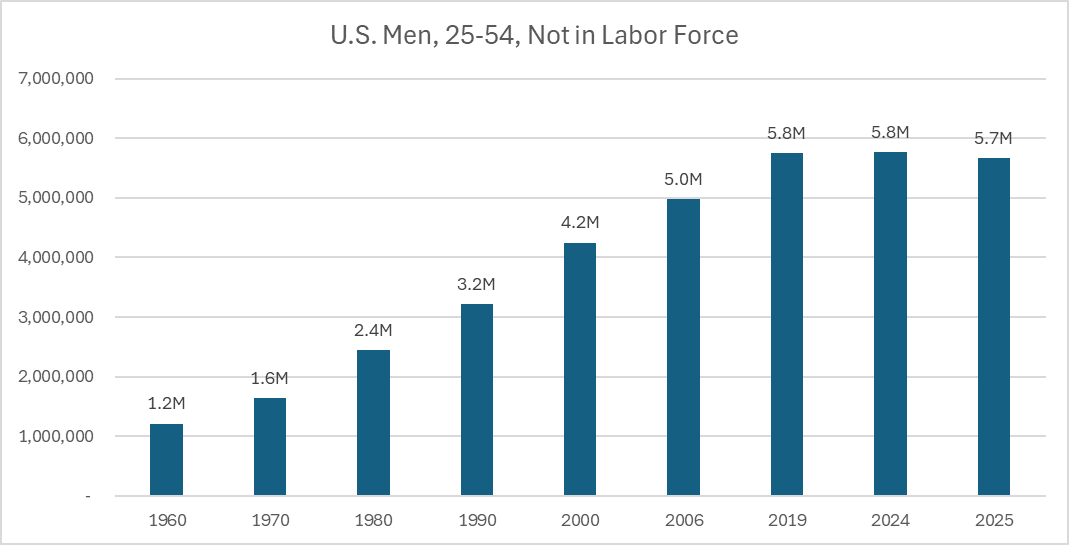
Nicholas Eberstadt, a scholar at the American Enterprise Institute, detailed this in his book Men Without Work. First released in 2016, he discovered that for every man who shows up in the official unemployment numbers, there were roughly three more who were completely out of the labor force. The headline unemployment rate (U-3)—has hovered around 4.3% to 4.5% the last few months, but it doesn’t see these men at all. They are statistical ghosts. The U-6 unemployment rate, which includes “all people marginally attached to the labor force, plus total employed part time for economic reasons…plus all people marginally attached to the labor force” provides a better picture of the labor market. The U-6 rate has been 8.0% to 8.7% since November 2025. But even this number does not completely account for the far too many who have given up.
“This is not about joblessness—it’s a retreat from adulthood, responsibility, and purpose,” Eberstadt wrote. They are refusing to leave the nest. Resorting to what is easy instead of choosing what is hard. It’s not all their fault. It’s a society-wide issue. It starts with parenting and continues with education. It’s not that they want work but can’t find it. They could work but aren’t. So what are they doing all day? There’s something deeper going on.
COVID turbocharged all of this, of course. Shutdowns combined with unprecedented unemployment benefits, stimulus payments, eviction moratoriums, and government expenditures basically paid men not to work. By 2022, over 11 million jobs were going unfilled while men sat on the sidelines.
It starts in high school and college. I started refereeing soccer games in eighth grade for cold hard cash. Then I was a lifeguard, summer camp counselor, and firework stand builder throughout summers in high school and college. But teenage boys and young men work much less these days. The 16 to 24 male labor force participation dropped from 61.6% in 2003 to 56.2% in 2023. The 20 to 24 male unemployment rate peaked at 9.9% in August 2025. Though this came down to 7.2% in January 2026, it has averaged 9.0% over the last 12 months.
I’m not saying everyone needs to be working in high school and college like I was every summer. Some students prioritize studying or athletics or social life. And that’s probably harmless, until graduation anyway. We should be on track to find our footing professionally by our early 20s. Then onto a career path or something to work toward by 25. Adulthood is being punted down the field… a trend that is not slowing, but accelerating.
To make things even crueler, AI is eliminating the first-rung of the career ladder. Entry-level jobs are already going away. Entry-level job postings have declined about 35% since January 2023, according to Revelio Labs. AI is not replacing jobs (yet), but it is depressing the number of white-collar job openings for workers with the least amount of experience. The grunt work, the boring, tedious drudgery. The work I cut my teeth on in the five years after I graduated (as a legal assistant, paralegal, then research analyst), is already shifting to the robots. If we over-automate, we shouldn’t be surprised that an entire segment of society is devoid of purpose and lacking meaning.
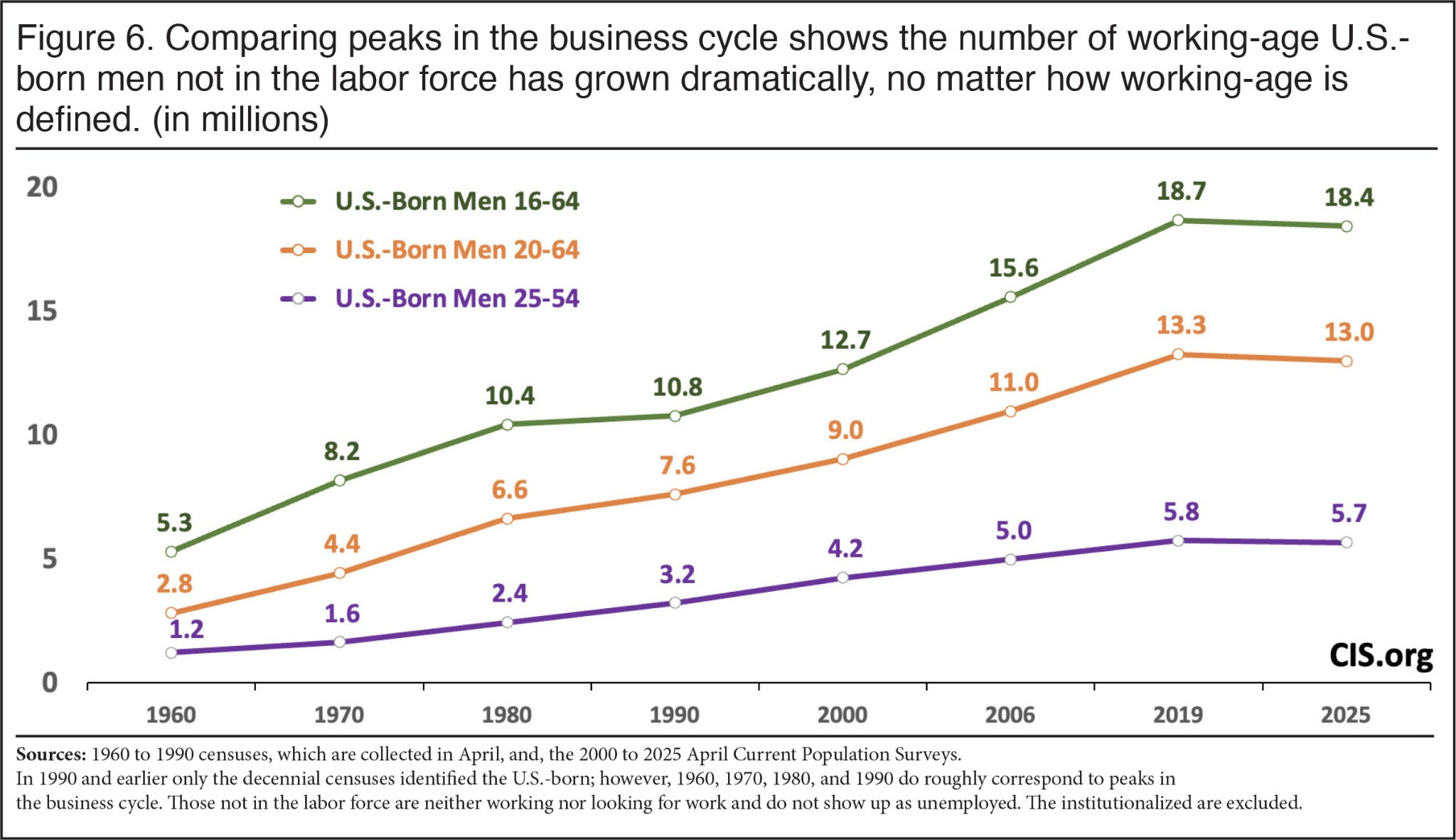
A college degree is becoming disconnected from professional success. As of mid-2025, male college graduates (ages 22-27) had roughly the same unemployment rate as the same aged men without a degree—about 7%. An entire generation has taken on debt in exchange for an opportunity that no longer exists.
These men out of work are not disabled, they’re without hope. They’re unable to get up and get after it. To contribute something, anything, to society. Time use data shows these men not in the labor force spend nearly 8 hours a day on socializing, relaxing, and leisure—with most of that watching TV, playing video games, or scrolling social media. There is plenty of work if you look to non-white collar occupations like construction or manufacturing. These men are either too good for that or too lazy to do anything.
Women are a completely different story. Though not without their own distinct problems, they are at least working. Women have entered the workforce in droves since the 1960s. Conversely from men, U.S.-born women, aged 25 to 54, have seen a 13% average decline (-2.0M per year) in the number of people out of the labor force from 1960 to 2000. It fell from 18.8 million in 1960 to 10 million in 2019.
The lack of men in the labor force and the dire straits facing young people today is perhaps the biggest issue that is getting the least amount of attention. There’s a deeper current to all of this. Men are not just without work or ambition to find work, they are also missing the most vital things that make life worth living, and are losing hope before they even become adults.
This has been happening across two generations now. Jonathan Haidt, in The Anxious Generation, traces the collapse back to the late 1970s, when boys started being pushed out of the real world and pulled into a virtual one. First by computers and video games, then by the internet and social media. By 2010, something snapped.
Suicide among men now accounts for nearly 80% of all suicides in the United States. Men are now four times as likely to kill themselves as women. Male suicide rates have increased by 30% since 2010 and 2022 was one of the highest rates in 70 years. Between 2010 and 2023, suicides for men aged 25 to 34 have increased 31%.
Social isolation is literally killing us.
Depression among teenage boys also rose 161% from 2010 to 2020. And the percentage of high school senior boys who agreed with the statement “people like me don’t have much of a chance at a successful life” has been climbing steadily since 1977, accelerating sharply after 2010 (Instagram launched in October 2010).
Video games make it easier for boys to retreat to their bedrooms instead of being outside with people face to face. The virtual world became more alluring year after year while social skills deteriorated. The real world, with all its friction, challenge, and opportunity, started to become optional. Growth was stunted. Resilience squandered. Potential out the window. The kids are not growing up.
The man spending his days on the couch in his thirties was the boy who spent his adolescence online. Eberstadt shows us the end of the story. Haidt shows us where it started and how it accelerated. The big question is: what is driving all this?
The Deeper Wound: Purpose, Direction, Meaning
Work doesn’t solve all your problems. But it does give you a sense of direction. A purpose in the chaos of it all. If you do it right and find something you’re good at or better yet, something you enjoy (or at least don’t hate), you’ll find meaning in it.
Young men don’t know what they’re doing. I didn’t have it all figured out when I was 21, however, I did have the drive to push myself until I got my feet under me.
Despite all its frustrations and limitations, work has always been one of the primary ways men answer the question of identity. What do you do? This question gets to who you are… what you spend your days doing. Though work is not the only thing that defines us, and shouldn’t be the only thing we portray ourselves as, when there’s no answer, just a black hole of despair, bad things happen. Not just a lack of confidence and income, but a lack of identity, and a propensity to fill that void with something dangerous.
Men often find themselves caught up in shifting identities. From high school athlete to college frat star to early career professional trying to climb the ladder. As seasons change, so do we. But too often, men give up when things don’t go their way. Refusing to tap into the well of resilience that lives inside all of us. Retreating inside ourselves. We get quiet. Disengage. Stop reaching out. Sit at home and watch the days pass by. And in an era of digital distraction… social media made for addiction, video games created to kill days of your life, pornography in everyone’s pocket… there is always somewhere to go. Even if this is not a physical space we go to, it is very easy to forget about all your problems. To pretend that everything is okay.
I understand how easy it is to fall into this spiral. When I was falling head first to the bottom in my mid-to-late twenties, alcohol and marijuana distracted me from the listlessness of my life. Always waiting impatiently for the next drunk, the next high, to take me out of my miserable state of mind and into an altered one.
Taking accountability is scary. Looking yourself dead in the eyes and asking ‘what the hell are you doing?’ Being honest with yourself instead of making a change to be better is easier said than done. Taking action to become the person you’re meant to be is impossible if we disappear into screens or substances. Creating before consuming is the way forward. Connecting instead of cowering can save your life. The momentum of directionlessness compounds. The more the hopeless young man sits on his couch and wastes his days away, the harder it is to believe he can become anything else. Purpose doesn’t come easy. It is built through effort, through challenge, through the experience of stepping outside of your comfort zone and discovering who you really are.
I refuse to believe all these men are lazy. That there’s no hope for them. Some people need help up to their feet. Others need a slap in the face. You can’t help someone who won’t help himself, but extending a lifeline and pushing them to strive for more can remind them that they matter and that it’s not too late to achieve great things.
The Collapse of Marriage
We aren’t getting married anymore.
In 1960, 72% of American adults were married. Flash forward to the present, for the first time in modern history, less than half of all U.S. households include a married couple.
Pew Research Center also discovered that the number of 40-year-olds who have never been married is skyrocketing. In 1980, just 6% of 40-year-olds were never married. By 2021, it was 25%. Men are also more likely to be unpartnered than women, which is a reversal from where things were in 1990. Among prime-working-age men, 39% were unpartnered in 2019, up from 29% thirty years earlier.
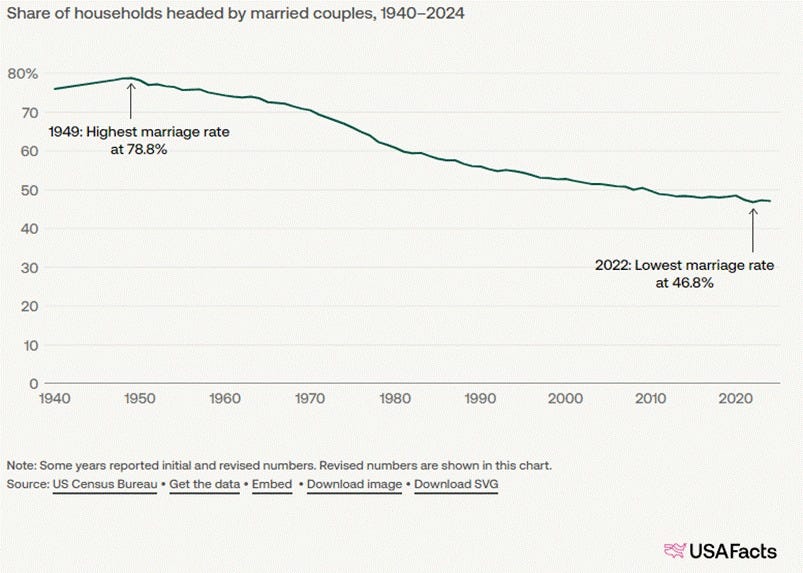
We’re getting married later now too. As adulthood starts later, so do the other things that come with it (we’re also not having kids anymore but we won’t get into that here). The median age for a man’s first marriage is now nearly 30 (I married at 31). Back in 1960, it was 23. Men are delaying marriage or forgoing it entirely.
Sure, marriage is not for everyone. And it’s incredibly hard. But marriage, for all its complexity, has been one of the most concrete ways to be financially stable, in addition to being an obvious route for men to find identity and purpose. Anything worth doing will be hard. The effort is worth the reward. Married men have been shown to earn more, live longer, and report higher life satisfaction than unmarried men. They are also more engaged at work, more connected to their communities, and more likely to be present in the lives of their children. The structure, the obligation, the shared daily struggles all help men grow into better people.
We were not meant to live alone but 13% of men do. We all need someone to come home to. We don’t all need to be married, but we need love, we need relationships, we need support, something outside ourselves to push us to strive and make something of each and every day.
Men without stable work won’t form families. Men without families have less reason to find work. Without higher stakes, we crumble and fail before we even start.
The Vanishing Home
Owning a home continues to be out of reach for too many. You own a home, you are literally and psychologically invested in the community around you. You have something to protect, maintain, and improve.
I bought my first house at 30. More than half of 30-year-olds were homeowners in 1970. Today, barely 13% are. This milestone of adulthood has become an exception.
Homeownership exploded from 44% in 1940 to more than 60% in the 1960s. The postwar boom kept homeownership there through the 1980s. Today, the homeownership rate sits around 65%, but that number hides the deeper reality.
According to Fortune, there are now more homebuyers over 70 than under 35.
Historically, 50%-65% of men owned homes by age 35. Today, that figure is down to 36%.
The median age of first-time homebuyers just hit a record of 40, up seven years since 2020, after averaging around 30 since 1981.
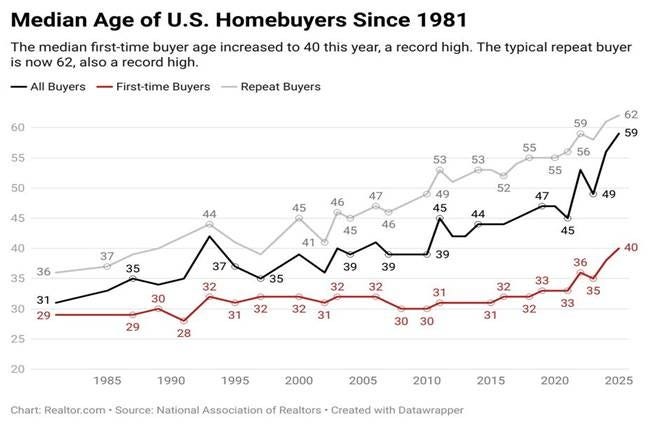
This is shocking but not surprising. We aren’t building enough homes where they’re needed most. And the homes we are building are not at price points most people can afford. Higher construction costs and development fees have driven home prices up well beyond the pace of incomes for at least 20 years. In many major metro areas, the median-priced home requires an income in the top quartile.
In 1980, more than half of 35-year-olds were married and owned a home. Today, just under 30% achieve this. The American Dream is on life support if not already dead.
The Friendship Recession and the Death of the Third Place
Robert Putnam saw it coming five years after I was born. In Bowling Alone—first an essay in 1995, then a landmark book in 2000—he documented the collapse of American civic life across virtually every measure: church attendance, union membership, PTA participation, neighborhood socializing, civic club membership. The average American attended 12 club meetings a year in the mid-1970s. By 1999, that number had fallen to five.
The web of relationships, obligations, and trust—Putnam called it social capital—was unravelling. Driven by television, suburban sprawl, and the erosion of shared spaces where people interacted together.
These trends have not reversed. They’ve accumulated over the years. With social media, porn, gambling, and remote work, we’re more isolated than ever. Connected virtually. Disconnected physically, emotionally, spiritually.
The Survey Center on American Life found 55% of men reported having six or more close friends in 1990. Today, that number has been cut in half to 27%. Even more stark is that the data point of men reporting zero close friends in 1990 was just 3%...today, it’s 15%. Young single men are most at risk. The number of single men under 30 with no close friendships is 28%.
I have very few friends. I am terrible at maintaining relationships and building new connections. Much of my social life revolves around my family. I go into the office four days a week just to have some face-to-face interaction. We don’t need a lot of friends to function, but we do need people in our lives we can share it with.
Men are navigating life’s hardest moments by themselves. White-knuckling. Winging it. Wondering how to move forward but never asking for help. Only 21% of men report getting emotional support from a friend in any given week, compared to 41% of women. Married men increasingly rely on their spouse as their only real confidant—which places enormous pressure on marriages. When those marriages fail, men have nothing underneath them. My wife is my life in a lot of ways. This is not healthy and I know I need my own people I can talk to and count on who is not married to me.
People aren’t going to church anymore either. Church attendance is now below 50% for the first time ever. All kinds of community organizations and groups have seen membership and attendance decline over the last 40 years. All while technology has become integrated in every aspect of our lives.
The third place, neither work nor home, where you met a neighbor or a friend, has largely disappeared, replaced by a phone in your pocket and an algorithm deciding what you see. Even at the gym I go to, everyone’s got their headphones in, living in their own world as we all quietly work out together.
We’re all alone. Together.
The Path Back
Now that we have the full picture, where do we go from here? I don’t really know what to do about this. I’m not an economist, psychologist, or sociologist. I don’t have a lot of friends and a full community I’m a part of. I’ve got a lot of issues personally and am at a crossroads professionally. But I’m working on all of that. What I do have is experience on how to build back from the bottom. The experience of being one of those men who was adrift, and the experience of scrambling back onto the path of purpose. And I think that experience points toward something the data alone can’t show.
We’re at a real crisis point. These young men without direction aren’t broken. They aren’t gone for good. They’re lost. They can be found again, but only if they step out of the shadows.
The path forward isn’t solely about jobs, programs, marriage, or housing, though all those things matter. The path out begins with a decision to take responsibility for the direction of your own life. I was numbing my pain for years with substances that held me back and made me forget what I was capable of. For a man who once gave up on himself while telling everyone he was fine, I can tell you that the decision to be honest about what is really going on and then to act anyway is genuinely hard. It’s probably the hardest thing I’ve ever done.
Derek Thompson, writer at The Atlantic and author of Abundance, concludes in The Monks in the Casino: “The alternative is staring us in the face, and like most true things, it is obvious but not simple. The game is being alive. It comes with tears and boredom and disappointments and deep, deep joy. It is meant to be played in the sun and in the shadows cast by other people.”
Life is full of pain. It’s not simple. It’s never straightforward. Feeling your way through the pain is the best way forward. Using that pain constructively, creatively, can bring great joy if done properly. It starts with finding out who you are and what you want to achieve, but it’s sustained by real and loving and supportive relationships with other people in real life who bring out the best in you.
Get up and find out what happens when you do what you think is impossible. Stand tall and be courageous. Keep showing up no matter what.
Start with something small. A job application. A workout. A call to a friend. Shift the narrative. Win the war in your mind. Alter the internal monologue from stagnation and fear to growth and opportunity. From victim to victor. Defeat to triumph. Look yourself in the eyes and become unshakable.
There’s a lot we need to do to turn things around…
We need the return of rites of passages. Things that turned boys into men. We need employers willing to take a chance on someone young and inexperienced but hungry and committed. We need communities full of spaces where connection and creativity and collaboration can happen. We need an education system that actually prepares our young men and women for the ever evolving labor market. We need to open up pathways to build back the American Dream with work that makes homeownership possible and careers that bring some sense of meaning.
And yet, we cannot do any of that unless we first acknowledge the severity of the issue.
Here are some things that helped me find my way back and build the life I always wanted.
Structure helps, but no amount of motivation will be enough if there’s no core belief in one’s self. No program rescues a person who thinks they’re beyond rescuing.
First step: be honest. Then, get out of the victim mentality doom loop. Look at the life you’re living and ask whether it’s the life you intended. If it’s not, then decide what you can change today. Pick one thing. And do it. Then do the next thing tomorrow.
Purpose is found through action. Through the accumulation of small acts of responsibility. Work is one path to it. Marriage, homeownership, and fatherhood are others. Community is everything.
All of the above requires showing up. Being present. Being honest. Being courageous.
I know young men without direction are not a lost cause because I was one of them. There is a way back. But you have to want it badly enough to get off the couch and take that first step.